Revealing the TikTok Ban
How long are we going to buy the narratives? There are serious issues with a large site like TikTok being temporarily banned without providing any legitimate measureable reasons. Forty-six years in the United…
How long are we going to buy the narratives? There are serious issues with a large site like TikTok being temporarily banned without providing any legitimate measureable reasons. Forty-six years in the United States, and still not have I witnessed a single Red Dawn moment from China. Why was the restriction put in place and then removed after only 17 hours? The ban’s briefness raises doubts as it inherently defies logic in terms of time, much like when one might question whether a 17-minute commercial flight across the U.S. is really feasible. Logically, we should question that amount of time. On the surface it did not make sense. Was it a policy test, a technical error, a calculated move, or a real ban? The need for transparency in promoting trust and comprehension during such occurrences is highlighted by the fact that there are some unexplained actions. The “smoke and mirrors” explanations and disinformation gets jolted when we start (and continue) to question and own the narrative ourselves–our own content, our own marks in history. As someone who works in the tech field, it became clear to me why TikTok was down for nearly a day. It transitioned from old servers, a Web2 platform to new servers, ushering in Web3. Am I speculating? Well, since Zuckerberg retired as our Czar of censorship, how about a novel concept? I will present my story and you decide for yourself. If you have not done this in a while, it might hurt. Let’s unpack what transpired January 18th to 19th in 2025 in the U.S. and more importantly why it matters.
By transitioning from a typical Web2 architecture to a Web3 base, TikTok has recently led a seismic upheaval in the online environment. This action was not motivated by government prohibitions or punitive actions, despite what many people think. Rather, it signifies a fundamental shift in the way platforms handle data and communicate with users. TikTok is establishing itself as a leader in the digital space by implementing Web3 technologies, positioning the platform as the Trojan Horse for decentralized systems.
The New Servers: Akamai Edge DNS in TikTok’s Transition (akamai.com)

Akamai Edge DNS, a state-of-the-art Domain Name System (DNS) service created to maximize speed, dependability, and security, lies at the heart of TikTok’s revolution. By dispersing DNS servers throughout the world, Akamai lowers latency and guarantees that user requests are sent to the closest data center. This is especially important for sites like TikTok, where sustaining user engagement requires smooth content delivery.
According to Akamai, its worldwide network can cut latency by as much as 50%, which is a big benefit for a platform that processes millions of uploads and views every day. Although even slight delays can have a detrimental effect on the user experience, TikTok is able to maintain optimal performance even during moments of high traffic thanks to Akamai’s infrastructure. TikTok’s move to Web3 is made possible by this technological foundation, which guarantees that the platform can provide a decentralized experience without sacrificing performance or dependability.
The Strategic Transition of TikTok to Web3
More than just a technological advancement, TikTok’s transition to Web3 is a daring declaration about the direction of digital interaction. Web3 is based on the ideas of decentralization, transparency, and user empowerment, in contrast to Web2, which depends on centralized management of user data and interaction rules. TikTok is establishing itself as a pioneer in a new wave of digital platforms that put user autonomy and data protection first by using Web3.
This change is in line with users’ growing worries about data privacy and traditional Web2 companies’ monopolistic behavior. More than 60% of internet users are concerned about their online privacy, per a World Economic Forum research. These issues are immediately addressed by TikTok’s usage of Web3 technologies, which provide users more control over their own data and online experiences. This calculated action not only improves TikTok’s operational structure but also establishes a standard for which other platforms must reach to stay relevant. Facebook seemed to take an abrupt turn recently. Hint. Hint.
Web2’s Drawbacks and the Emergence of Web3
Web2, which is typified by centralized platforms like Facebook, Google, and Twitter, has long dominated the digital ecosystem. Large volumes of user data have been gathered by these platforms, which frequently profit from it without enough disclosure or user consent. 79% of Americans are worried about how businesses exploit their data, according to a Pew Research Center research. Numerous problems, such as data breaches, false information, and a lack of user agency, have resulted from this centralized architecture.
The need for a decentralized alternative has increased as Web2’s drawbacks become more obvious. Decentralized apps (dApps) and blockchain technology provide a workable answer, giving consumers back control over their interactions and data. An important step in this direction is TikTok’s move to Web3, which challenges the established quo and opens the door to a more just digital ecology.
Decentralized vs. Centralized: A Change in Perspective
The transition from Web2 to Web3 represents a significant alteration in the functioning of digital systems. There are serious privacy and security issues with Web2 because it depends on centralized platforms that manage user data and set terms of engagement. Web3, on the other hand, is based on the ideas of user empowerment, transparency, and decentralization. Web3 platforms leverage blockchain technology to let users own their data and communicate with each other directly, doing away with the need for middlemen. In addition to improving security and privacy, this promotes user community and trust.
Key Distinctions Between Web2 and Web3: Ledger vs. Blockchain
Web2: Depends on conventional ledgers that are opaque and prone to manipulation and are kept up to date by centralized organizations.
Web3: Makes use of blockchain technology, a decentralized, unchangeable record that guarantees data transparency and integrity.
App versus dApp
Web2: Due to the fact that centralized apps rely on a single server, they are susceptible to data breaches and downtime.
Web3: Blockchain-based decentralized apps (dApps) provide increased security, robustness, and user control.
Traditional Contract vs. Smart Contract
Web2: Conventional contracts necessitate middlemen and are frequently cost-inflated and time-consuming to implement.
Web3: Smart contracts automate agreements by using self-executing code, which lowers costs and boosts confidence.
Comparing the Public Key and Account Number
Web2: Since account numbers are linked to private data, identity theft is more likely.
Web3: Public keys improve security and privacy by offering safe, anonymous access to digital assets.
PIN Code vs. Private Key
Web2: Passwords and PIN codes are susceptible to loss and hacking.
Web3: Although private keys provide strong security, they must be used cautiously because they cannot be replaced.
Ownership of Data and Control of Access
With abysmal consideration for user privacy or agency, Web2 businesses frequently take advantage of user data for financial gain. This paradigm is reversed by Web3, giving users complete ownership over their data and the ability to choose how it is shared and made profitable. This change provides people more control over their online persona and fosters a more just digital ecosystem.
The Function of ICANN in Web3 Infrastructure Verification
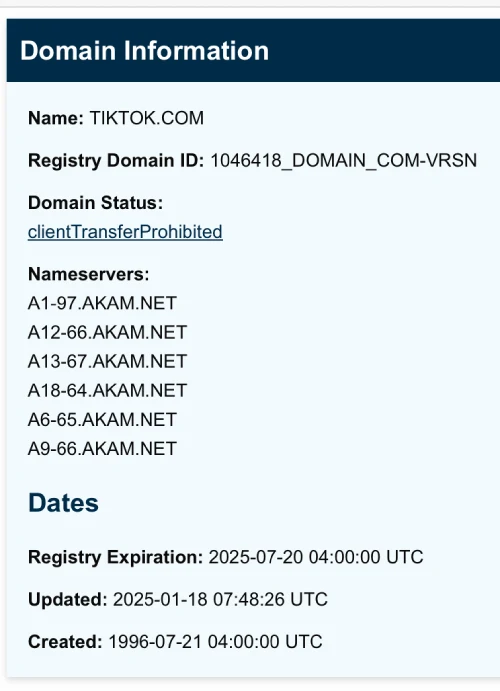
In order to manage IP addresses and domain names, the Internet Corporation for Assigned Names and Numbers (ICANN) is essential. By confirming DNS records, ICANN’s lookup services give users transparency by letting them know where their data is hosted and how it is handled. Gaining confidence in TikTok’s Web3 architecture requires this degree of openness.
Here is where we can do a hard “fact check” and find the evidence of the transition to new servers for the TikTok platform.
Due to its shift to Web3, TikTok is now positioned as a decentralized technology Trojan Horse. TikTok has the ability to introduce millions of people to the advantages of decentralization through its enormous user base and captivating content. Users may be more receptive to investigating other Web3 developments, including decentralized finance (DeFi) and non-fungible tokens (NFTs), as they acquire greater control over their data and interactions.
Digital Interaction’s Future
More than just a technological advancement, TikTok’s transition to Web3 offers a preview of a time when platforms will place a higher value on user agency, privacy, and innovation. TikTok is creating a more user-centric and egalitarian environment by adopting decentralization and establishing a new benchmark for digital platform operations. We can anticipate a wave of innovation that reinterprets the relationship between platforms and their users as more businesses follow suit.
Connecting the Dots
The change from Web2 to Web3 represents a significant change in the way we communicate with technology and one another. We open the door to a more user-centric, safe, and just digital future by shifting from centralized control to decentralized autonomy. One important step in this direction is TikTok’s use of Web3 technology, which presents a positive outlook for a day when platforms function with more openness and respect for user rights.
It’s critical that we be educated, involved, and proactive in influencing the direction of the digital world as we traverse this shift. TikTok’s action is about taking back control and autonomy in our digital lives, not just about adopting new technologies. Web3 has enormous potential to empower people and spur innovation, yet the path to it is only getting started. In the meantime, stop following stories from the media and start writing your own. Welcome to the Web3 Revolution. The time is now. Tick. Tock.
By Jeff Glass, CEO of MetaTech Web Solutions